Hurun Richest Self-Made Women in the World 2026
The Hurun Research Institute today released the Hurun Richest Self-Made Women in the World 2026, a list of the self-made women billionaires in the world. This is the 14th year of the list. Wealth is a snapshot of 15 January 2026, drawn from the recently released Hurun Global Rich List 2026. Note that comparatives are with the last list, released three years ago in 2023.
HURUN RESEARCH RELEASES HURUN SELF-MADE WOMEN BILLIONAIRES 2026
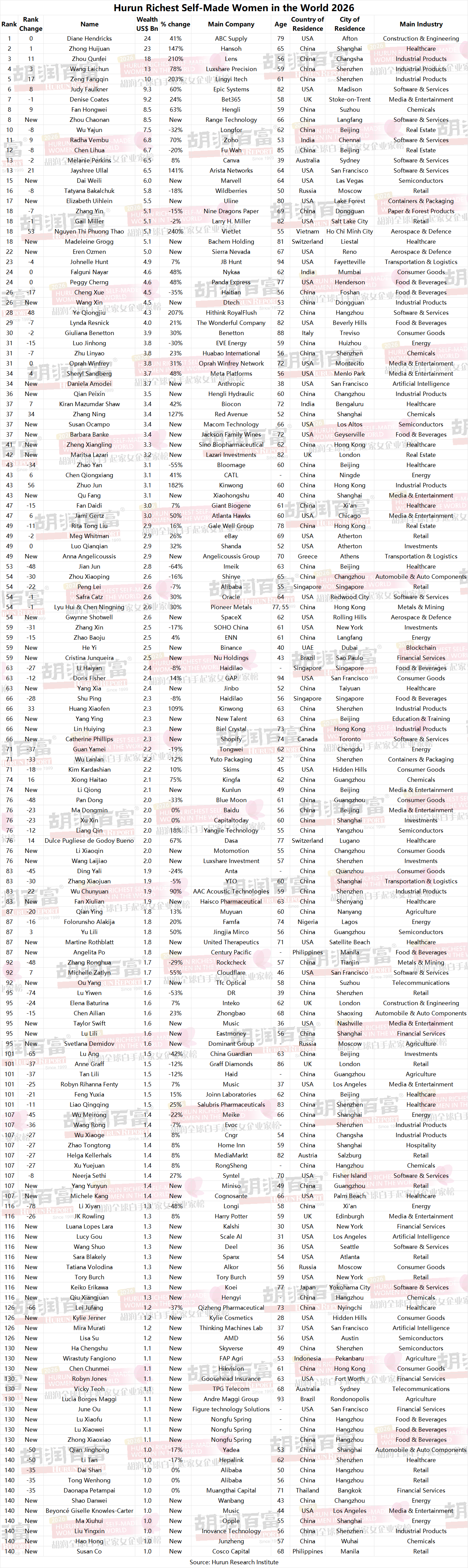
150 SELF-MADE WOMEN BILLIONAIRES IN THE WORLD, HIGHEST IN 15-YEAR HISTORY OF THE LIST AND DOUBLE THAT OF 10 YEARS AGO
AMERICAN 'ROOFING QUEEN' DIANE HENDRICKS, 79, OF WISCONSIN-BASED ABC SUPPLY, with us$24bn, RETAINS CROWN of WORLD'S RICHEST SELF-MADE WOMAN FOR SECOND time
SHANGHAI-BASED ZHONG HUIJUAN OF DRUG MAKER HANSOH IS BIGGEST RISER, MORE THAN DOUBLING IN THREE YEARS TO US$23BN, CEMENTING HER AS ASIA'S RICHEST SELF-MADE WOMAN AND SECOND PLACE OVERALL; ‘TOUCHSCREEN QUEEN’ ZHOU QUNFEI OF CHANGSHA-BASED LENS IS THIRD, TRIPLING WEALTH TO US$12.2BN GAIN
CHINA DOMINATES WITH 52% OR 78 SELF-MADE WOMEN BILLIONAIRES; USA SECOND WITH 40, UK THIRD WITH 5
TOTAL WEALTH OF SELF-MADE WOMEN BILLIONAIRES US$470BN, UP 52% IN THREE YEARS
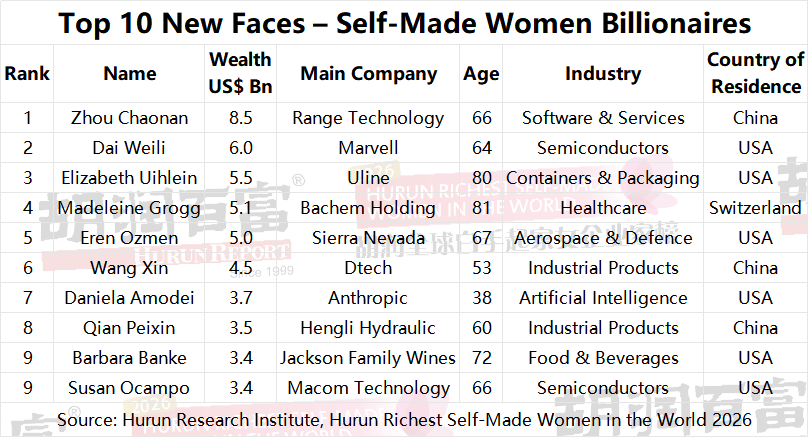
60 NEW FACES, LED BY ZHOU CHAONAN OF data center provider RANGE TECHNOLOGY AT US$8.5BN
SHENZHEN RETAINS ITS CROWN AS WORLD'S SELF-MADE WOMEN BILLIONAIRE CAPITAL WITH 13; SAN FRANCISCO ONLY NON-CHINA CITY TO CRACK TOP FIVE CITIES
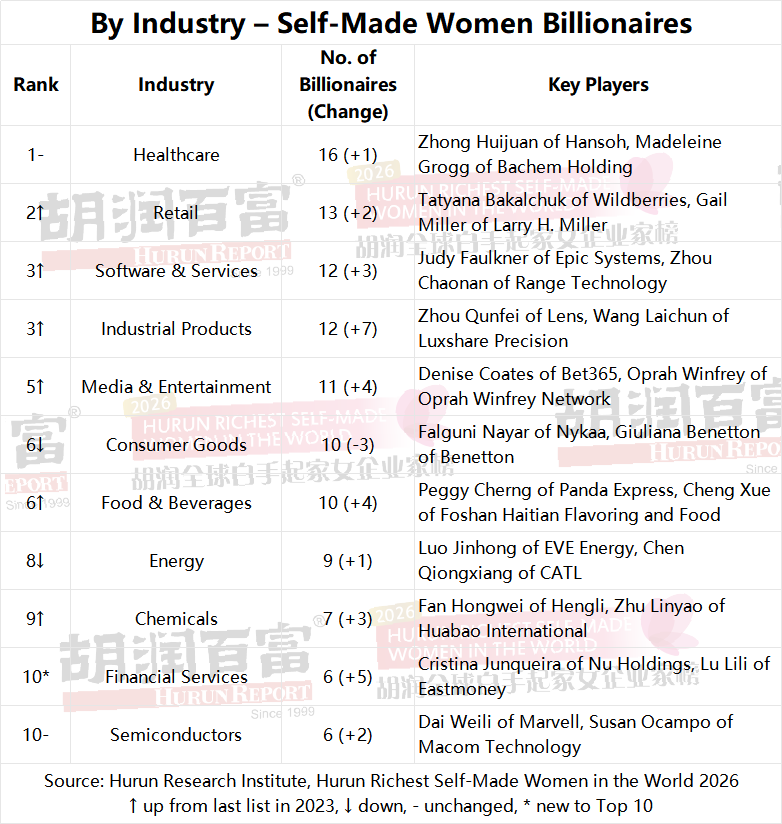
HEALTHCARE LEADS WITH 16 SELF-MADE WOMEN BILLIONAIRES, AHEAD OF RETAIL (13) AND SOFTWARE & SERVICES AND INDUSTRIAL PRODUCTS (12 EACH); SEMICONDUCTORS ENTERS TOP 10 FOR FIRST TIME
680 WOMEN ON RECENTLY-RELEASED HURUN GLOBAL RICH LIST 2026, ACCOUNTING FOR 17% OF TOTAL BILLIONAIRES IN WORLD. 22% ARE SELF-MADE, 78% INHERITED their WEALTH
AI EMERGES AS A NEW WEALTH CATEGORY WITH FOUR NEW FACES: DANIELA AMODEI OF ANTHROPIC (US$3.7BN), LUCY GUO OF SCALE AI (US$1.3BN), LISA SU OF AMD (us$1.2BN) AND MIRA MURATI OF THINKING MACHINES LAB (US$1.2BN)
KYLIE JENNER, 28, YOUNGEST SELF-MADE WOMAN BILLIONAIRE AT US$1.2BN. OF THE 150 SELF-MADE WOMEN BILLIONAIRES, 10 ARE UNDER40, OF WHICH 3 ARE UNDER35, AND ONE IS UNDER30.
Hurun Research Institute releases Hurun Richest Self-Made Women in the World 2026
(17 March 2026, Shanghai, China, Mumbai, India, Oxford, UK) The Hurun Research Institute today released the Hurun Richest Self-Made Women in the World 2026, a list of the self-made women billionaires in the world. This is the 14th year of the list. Wealth is a snapshot of 15 January 2026, drawn from the recently released Hurun Global Rich List 2026. Note that comparatives are with the last list, released three years ago in 2023.
Hurun Research Institute found 150 self-made women billionaires from 20 countries.
115 saw their wealth increase, of which 60 were new faces, whilst 50 saw their wealth go down or stay the same, of which 15 dropped out entirely. Total wealth was up 52%, from US$310bn in 2023 to US$470bn in 2026, with 63% making their money from listed companies.
The average age was 61 years old, five years younger than the average age of the recently-released Hurun Global Rich List. 12 women are Under40s, ie aged 40 & under.
53% sell to businesses, while 47% sell directly to consumers. 62% make physical products, whilst 38% sell software & services.
Rupert Hoogewerf, chairman and chief researcher of Hurun Report, said
“The number of self-made women billionaires has doubled in ten years to a new world record of 150. The drivers reflect a remarkable convergence of China ‘going global’, a surging AI economy, and a global healthcare wave that has together created wealth at a pace we have not seen since the list began fifteen years ago. What makes the Hurun Richest Self-Made Women in the World 2026 so compelling isn't just the numbers; it's the stories behind them.”
“What is remarkable is how wealth creation for women has changed so dramatically. Over 80% of this year’s list were not on the list ten years ago, evidence that women are finding unprecedented opportunities to build large businesses, reflecting a transformative shift in the entrepreneurship ecosystem.”
“China's grip on self-made women's wealth has never been stronger, with more self-made women billionaires than the rest of the world combined, suggesting that China has the best ecosystem in the world when it comes to gender equality in business. As well as the 78 based in China, there are a further eight that have emigrated, mainly to the US and Singapore, led by Shanghai-born Dai Weili of Marvell, Chongqing-born Lucy Peng Lei of Alibaba and Beijing-born Zhang Xin of SOHO. China's dominance is being driven by the same forces reshaping the global economy: manufacturing, pharmaceutical innovation and the AI hardware supply chain.”
“The USA, in second place with 40, is growing fast but remains a distant second, mainly focused on Software & Services (6 women, $22.8bn) and Media & Entertainment (6 women, $14.6bn), with 58% in digital/service-based businesses versus China's manufacturing and industrial products concentration.”
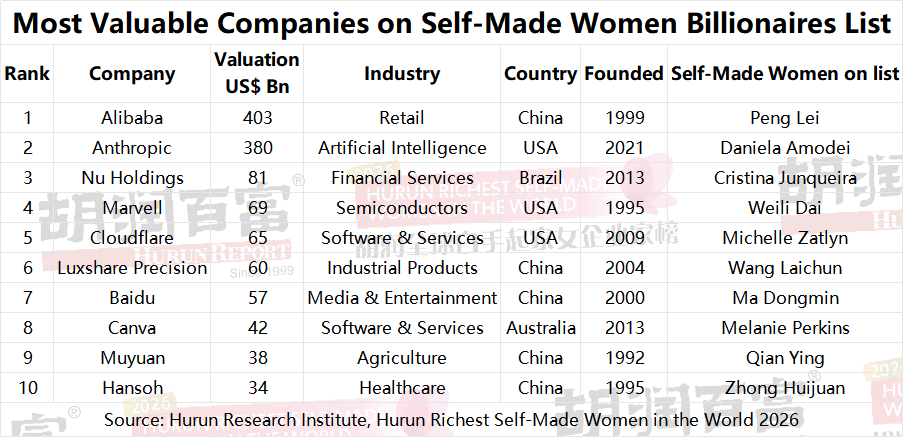
“The Top 10 most valuable companies, founded or co-founded by self-made women billionaires, collectively represent an extraordinary testament to female entrepreneurship and show how these women are closing the gender gap in access to capital and representation at the highest levels of global business. Together, these ten companies are worth a combined valuation of US$1.2 trillion. Alibaba, co-founded by Lucy Peng Lei and Trudy Dai Shan, leads at US$403bn, followed by Anthropic, co-founded by Daniela Amodei, at US$380bn, Nu Holdings, co-founded by Cristina Junqueira at US$81bn, Marvell, co-founded by Dai Weili, at US$69bn, Cloudflare co-founded by Michelle Zatlyn at US$65bn and Luxshare Precision, founded by Grace Wang Laichun, at US$60bn. But beyond the headline names, several other companies deserve recognition. Xiaohongshu, co-founded by Miranda Qu Fang, has grown to become a short-video platform worth US$31bn. Lens Technology and founded by June Zhou Qunfei, is now worth US$28bn as one of the world's largest consumer electronics contract manufacturers. These women have proven their ability to not just found companies, but to scale them to multi-billion dollar valuations across technology, manufacturing, fintech, and traditional industries.”
“Four in ten of the world’s self-made women billionaires joined early-stage companies and drove them to extraordinary scale, becoming billionaires in the process and collectively representing US$191 billion in wealth. Notable examples include Jayshree Ullal at California-based Arista Networks ($6.5bn), Sheryl Sandberg at Meta ($3.7bn), Meg Whitman of eBay ($2.9bn), Gwynne Shotwell at SpaceX ($2.6bn), Safra Catz at Oracle ($2.6bn), Lisa Su of AMD ($1.2bn) and Tong Wenhong of Alibaba ($1bn). These women demonstrate that executive leadership positions can be as wealth-generating as founding companies outright.”
“Celebrities and influencers represent a small but notable segment of the list, with 7 self-made women billionaires. Led by Oprah Winfrey ($3.8bn) through her Oprah Winfrey Network, this group includes Kim Kardashian ($2.2bn, Skims), Taylor Swift ($1.6bn), Rihanna ($1.5bn), JK Rowling ($1.3bn), Kylie Jenner ($1.2bn, Kylie Cosmetics), and Beyoncé ($1bn). While media and entertainment dominate with 5 representatives, the shift toward consumer goods, particularly beauty and fashion brands like Skims and Kylie Cosmetics, signals that modern celebrity wealth increasingly stems from product ownership rather than traditional entertainment revenue alone.”
“India is grabbing the global spotlight with a powerhouse trio of self-made women billionaires: Radha Vembu of Chennai-based business management systems platform Zoho ($6.8bn), Falguni Nayar of Mumbai-based lifestyle and beauty retailer Nykaa ($4.6bn), and Kiran Mazumdar Shaw of Bangaluru-based drug maker Biocon ($3.4bn). Together, their success showcases India's rapidly maturing ecosystem for women in business.”
“Women make up 6% of the world’s 2600 self-made billionaires in the world. The sectors these self-made women billionaires are breaking into are equally telling. 11% of the list are doing Healthcare, for example, compared with 8% for men. Semiconductors, once an almost exclusively male domain, saw four new self-made women billionaires, compared with twenty self-made men billionaires, a ratio that would have been unthinkable a decade ago.”
"The doubling of self-made women billionaires to a record 150 in just a decade is not simply a wealth story; it is a story of economic empowerment and inclusive growth at a global scale. Women are now leading innovation across artificial intelligence, healthcare, and advanced manufacturing, with the self-made women billionaires collectively commanding US$470 billion in wealth and building companies valued at over US$1.2 trillion. Yet with women's entrepreneurial leadership still in its early chapters, the gender gap in entrepreneurship and access to capital remains stark. The opportunity cost of that gap is immeasurable. Closing it is not a matter of equity alone; it is the defining inclusive growth imperative of our generation."
“Today's newest self-made women billionaires aren't emerging in a vacuum; they are the product of a powerful 'alumni effect' from top tech institutions. Daniela Amodei, 38, and Mira Murati, 37, helped build OpenAI before charting their own monumental paths in generative AI, much like Lucu Guo, 31, parlayed early roles at Snapchat into co-founding Scale AI. By cutting their teeth at these global tech epicentres, they are turning elite institutional pedigree into unprecedented entrepreneurial wealth.”
“Philanthropy is emerging as a defining feature of women's wealth. Since her divorce from Jeff Bezos, MacKenzie Scott has donated US$26 billion, and becoming the largest woman donor in the world. Among the self-made cohort, Judy Faulkner of Epic Systems ($9.3bn) has pledged to give away the majority of her wealth, while Oprah Winfrey ($3.8bn) continues decades of charitable work in education and empowerment, and JK Rowling famously gave away enough to temporarily lose billionaire status before rebuilding her $1.3bn fortune, demonstrating that for many women, wealth creation and social impact are inseparable.”
“Artificial intelligence has produced its first cohort of self-made women billionaires. Daniela Amodei of Anthropic, Lucy Guo of Scale AI, and Mira Murati of Thinking Machines Lab have all debuted this year by building foundational AI platforms. Crucially, they are joined by Lisa Su of AMD, whose leadership in semiconductors is providing the massive computing power required to run this AI revolution. Together, they reflect a broader shift across the global economy: AI is no longer just a technology story, it is now a wealth creation story.”
“The newest vanguard of self-made women billionaires is emerging at unprecedented speeds, led by innovators at the helm of super young companies. At the absolute frontier is Anthropic, yet to celebrate its fifth anniversary, which is driving the explosive generative Artificial Intelligence industry. However, this hyper-accelerated wealth creation extends beyond AI; it is mirrored in the disruption of global workforce management by Wang Shuo’s Deel (2019), the blockchain fintech innovations of June Ou’s Figure (2018), and the modern retail revolution of Kim Kardashian’s Skims (2019). These enterprises underscore a profound shift in the modern economy: whether building the intelligence infrastructure of tomorrow, redefining global financial technologies, or dominating digitally native consumer markets, today's most accelerated engines of billion-dollar valuations are being architected by women, accelerating a generational shift in women's leadership across the digital economy.”
“Three of the five biggest wealth gainers on this year's list make the components inside your devices and AI infrastructure, a clear sign that the hardware powering the tech revolution is creating fortunes just as fast as the software running on it. China consumer electronics contract manufacturing has been propelled by June Zhou Qunfei of Lens, Grace Wang Laichun of Luxshare and Zeng Fangqin of Lingyi.”
“Healthcare has long dominated the ranks of self-made women billionaires, and it continues to lead, driven by pharmaceutical and biotechnology powerhouses such as Zhong Huijuan of Hansoh, Kiran Mazumdar Shaw of Biocon and Zhao Yan of Bloomage, with 16 billionaires to its name.”
“What surprises me is that only 20% of the world’s self-made billionaires come from countries outside of China and the US, led by the UK, Singapore, Russia and India. By comparison, the percentage of self-made male billionaires from countries outside of China and the US is almost double, at 35%. Traditional power houses of gender equality in Europe don’t seem to generate self-made billionaires. The only ones from Europe are Greek ship builder Anna Angelicoussis, Switzerland-based Madeleine Grogg of healthcare researcher Bachem and Italy-based Giuliana Benetton of clothing brand Benetton. The edges of the map are shifting: Melanie Perkins of Australia-based graphic design platform Canva, Tatyana Bakalchuk of Russia-based Wildberries, Nguyen Thi Phuong Thao of VietJet in Vietnam, Falguni Nayar of Mumbai-based Nykaa and Cristina Junqueira of Nu Holdings in Brazil, a clear sign that inclusive growth and women's economic participation are becoming truly global forces, not regional exceptions.”
“Sports team ownership has become a strategic investment for 10 self-made women billionaires (7% of the list), collectively worth $34.9 billion, led by Denise Coates of Bet365 ($9.2bn, Stoke City FC) and Gail Miller ($5.1bn, Utah Jazz). Teams have appreciated 500% over two decades, offer unique tax advantages through purchase price amortization, and provide diversified revenue beyond the core business while delivering prestige and community influence.”
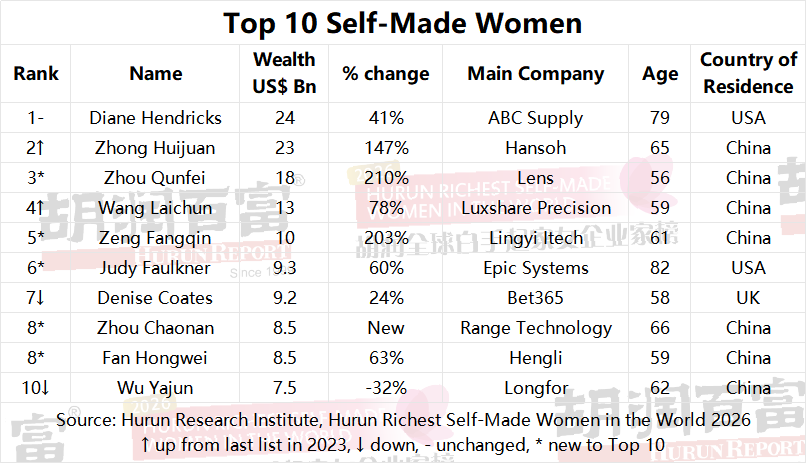
The Hurun Top 10
The Hurun Top 10 self-made women span just two countries, China and the US, with Chinese commanding 7 of the 10 spots, reflecting the scale of women creating wealth across China’s manufacturing, healthcare, and industrial sectors. Diane Hendricks leads with US$24bn, built on her roofing supply empire ABC Supply, followed by Zhong Huijuan, whose landmark US$1.5bn cancer drug licensing deal with Roche propelled Hansoh Pharmaceutical to global biotech prominence.
Consumer electronics contract manufacturing is a rare industry where the three biggest players are all women. June Zhou Qunfei of Lens Technology, Grace Wang Laichun of Luxshare and Zeng Fangqin of Lingyi Itech have seen their wealth double or even triple in the past three years, on surging demand for consumer electronics as China ‘goes global’.
Judy Faulkner was 6th, up 60%, anchoring the US presence with Epic Systems’ AI-driven healthcare software expansion. Fan Hongwei was up 63% to US$8.5bn as Suzhou-based Hengli powered up its new shipbuilding business into the world’s top tier, whilst its petrochemical business continued to grow. ‘Data Center Queen’ Zhou Chaonan was the highest new entrant on the list, shooting straight into the Hurun Top 10 as Range Technology’s cloud data center boomed. Curiously, ‘Chaonan’ is Chinese for ‘to surpass men’. ‘Online Gambling Queen’ Denise Coates is the UK’s richest self-made woman, as Bet365 saw its business continue to grow. Former Number One, Wu Yajun of Longfor, was down a third to US$7.5bn as China’s property market continued to feel the pressure.
Table 1: Top 10 Self-Made Women
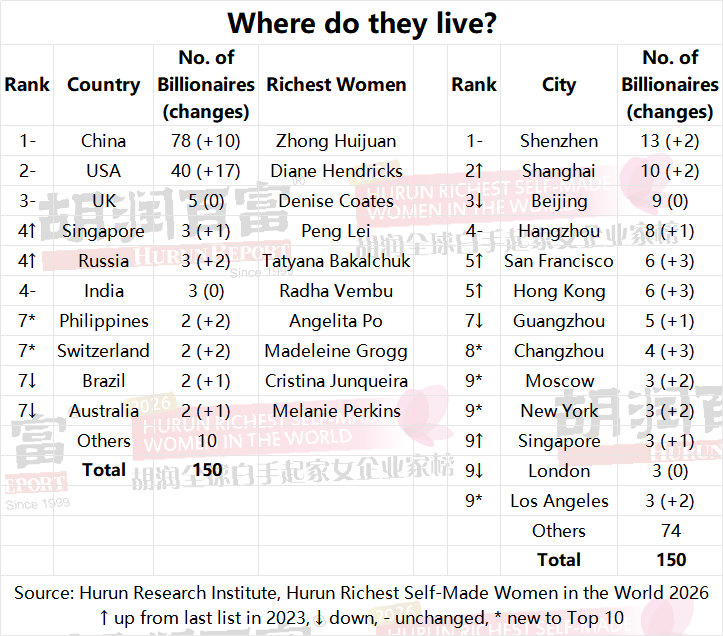
Where do they live?
China dominates with more self-made women billionaires than the rest of the world combined. The US had a good year, adding 17 women self-made billionaires.
On the city front, Shenzhen retains its crown as the world’s self-made women billionaire capital with 13, followed by Shanghai with 10 on second rank and Beijing with 9, on third, while Hangzhou secured fourth with 8. The fact that seven of the eight top cities are all from China tells a story in itself.
Table 2: Where do they live?
Which Industries generate the most Wealth?
The entry of Semiconductors at tenth, led by Dai Weili of Marvell and Susan Ocampo of Macom Technology, as well as Lisa Sun of AMD, signals a pivotal shift toward deep-tech as a new frontier of women’s wealth creation globally.
Table 3: By Industry – Self-Made Women Billionaires
Most Valuable Companies
At the top sit Alibaba and Anthropic, both worth around US$400bn, followed by 31 companies worth over US$10bn.
Alibaba, worth US$403bn, is where Lucy Peng Lei and Trudy Dai Shan are two of the 18 co-founders, who launched the company in 1999. Alibaba has become China's dominant e-commerce platform and one of the world's most valuable retail technology companies, transforming commerce for hundreds of millions of consumers and businesses across Asia and beyond.
Artificial intelligence claims second place. Anthropic at US$380bn is the standout riser and the sole AI-native company in the Top 10. Founded in 2021 by former OpenAI researchers. Daniela Amodei, 38, serves as co-founder and President, one of four Anthropic co-founders on the recently released Hurun Global Under40s Self-made Billionaires list, each with US$3.7bn.
The table's technology and semiconductor cohort demonstrates substantial depth. Nu Holdings takes third place at US$81bn, co-founded by Cristina Junqueira, representing the sole financial services company in the Hurun Top 10 and Latin America's largest digital bank. Marvell at US$69bn, co-founded by Dai Weili in 1995, has established itself as a major semiconductor solutions provider. Cloudflare holds steady at US$65bn, co-founded by Michelle Zatlyn in 2009, providing essential internet infrastructure and security services globally. Luxshare Precision at US$60bn, founded by Wang Laichun in 2004, has become a critical supplier in the electronics manufacturing supply chain, particularly for Apple.
Chinese technology and media platforms feature prominently. Baidu at US$57bn, co-founded by Melissa Ma Dongmin in 2000, pioneered China's search engine market and has evolved into a leading player in AI and autonomous driving technology. Canva at US$42bn, co-founded by Australian entrepreneur Melanie Perkins in 2013, remains one of the most valuable private software companies outside the USA, democratizing graphic design for millions of users worldwide.
Rounding out the table, traditional industries show enduring strength. Muyuan at US$38bn, where Qian Ying co-founded the company in 1992, represents China's agriculture sector as one of the country's largest pig farming operations. Hansoh Pharmaceutical at US$34bn, founded by Zhong Huijuan in 1995, has become one of China's leading innovative pharmaceutical companies, focusing on oncology, metabolic diseases, and central nervous system treatments.
Other notable companies co-founded by women on the Hurun list include Xiaohongshu (US$31bn) co-founded by Miranda Qu Fang; Lens Technology (US$28bn) founded by Zhou Qunfei, Hengli (US$24bn) co-founded by Fan Hongwei; Tfc Optical (US$22bn) founded by Ou Yang, ABC Supply (US$23bn), United Therapeutics (US$21bn), Epic Systems (US$21bn), J.B. Hunt (US$20bn), Deel and Figure Technology Solutions (US$17bn).
Table 4: Most Valuable Companies on Self-Made Women Billionaires List
Who’s up?
115 saw their wealth increase, of which 60 were new faces.
The 2026 list tells a story of seismic industrial shifts, where the sectors defining the next decade of global growth are now the same ones minting the most powerful self-made women in the world.
Healthcare still claims the single biggest wealth gain, Zhong Huijuan's $14 billion surge at Hansoh Pharmaceutical, fuelled by a landmark $1.5 billion cancer drug licensing deal with Roche, puts a Chinese drug maker at the very top of the risers’ table. But the sector's dominance is no longer uncontested. Industrial Products, specifically the precision component manufacturers powering the AI hardware revolution, now rival healthcare as the defining wealth engine of this era. Zhou Qunfei of Lens Technology added $12 billion riding soaring demand for smart device components and AI hardware screens, while Wang Laichun and Zeng Fangqin added over $12 billion combined through Luxshare Precision and Lingyi iTech, both deeply embedded in the Apple supply chain and consumer electronics ecosystem. Together, Industrial Products women hold $62 billion in wealth across 12 billionaires, marginally ahead of Healthcare's $58 billion across 16, a remarkable milestone that would have been unthinkable even five years ago.
Software & Services rounds out the top three sectors by total wealth at $52 billion, led by Judy Faulkner of Epic Systems and Ye Qiongjiu of Hangzhou-based Hithink RoyalFlush; a reminder that enterprise software and fintech platforms continue to generate fortunes steadily, even as hardware captures the headlines.
The new entrants paint an equally compelling picture of where women are breaking through for the first time, where technology and its adjacent industries dominate. Zhou Chaonan debuts at $8.5 billion through Range Technology's cloud data centre business in China, while Dai Weili enters at $6 billion via Marvell, one of three semiconductor newcomers on the list alongside Susan Ocampo of Macom Technology and Lisa Su of AMD, signalling that chipmaking is fast becoming a defining arena for women's wealth creation. Gwynne Shotwell of SpaceX and Eren Ozmen of Sierra Nevada represent a breakthrough moment for Aerospace & Defence standing as one of the most remarkable self-made journeys on the entire list.
What unites this year's risers and new entrants is not just wealth, but timing. The women gaining the most ground right now are those who, years or decades ago, planted themselves at the intersection of technology, manufacturing, and healthcare; the three forces quietly rewiring the global economy.
Table 5: Biggest Risers – Self-Made Women Billionaires
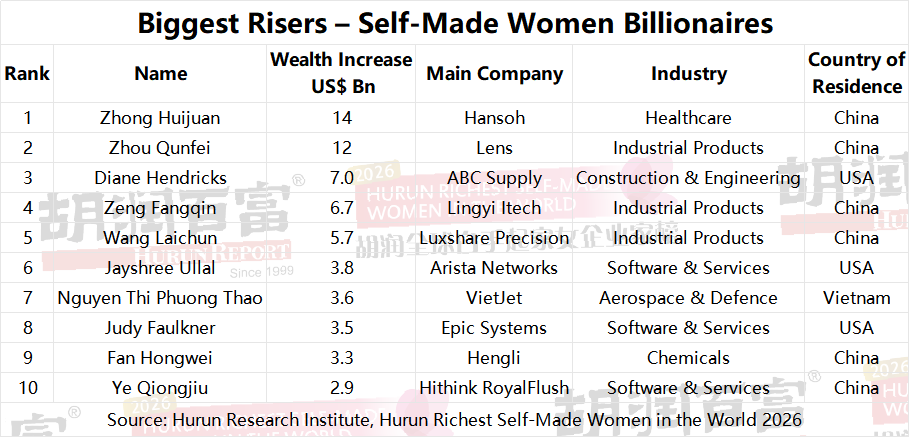
Table 6: Top 10 New Faces – Self-Made Women Billionaires
And, who’s down?
50 saw their wealth go down.
Healthcare sits at the center of the most striking paradox of the year, the sector that produced the single biggest winner also inflicted the two deepest wounds. While Zhong Huijuan's pharmaceutical empire surged on oncology breakthroughs and global licensing deals, China's consumer-facing biotechnology tells a completely different story. Jian Jun of Imeik, whose injectable aesthetics empire was worth $8 billion in 2023, has lost $5 billion in three years, a 64% collapse, as competition intensified and its products lost their shine. Zhao Yan of Bloomage, built on similar foundations in hyaluronic acid skincare, lost $3.8 billion over the same period, her wealth more than halved. Together, nearly $9 billion has been erased from healthcare's biotechnology wing alone. Beyond biotech, Wu Yajun of Longfor continues her prolonged descent, losing another $3.5 billion as China's property crisis compounds into its fourth consecutive year, her wealth down from $11 billion in 2023 to $7.5 billion today. Cheng Xue, once worth nearly $7 billion, shed $2.4 billion as Haitian’s compitition picked up, while Lu Yiwen's jewellery brand DR tells perhaps the sharpest individual story, her fortune more than halved from $3.7 billion to $1.6 billion in just three years, on the back of controversial marketing, declining marriage rates, and a shift in consumer preferences toward value-oriented purchases rather than traditional, high-priced diamond engagement rings.
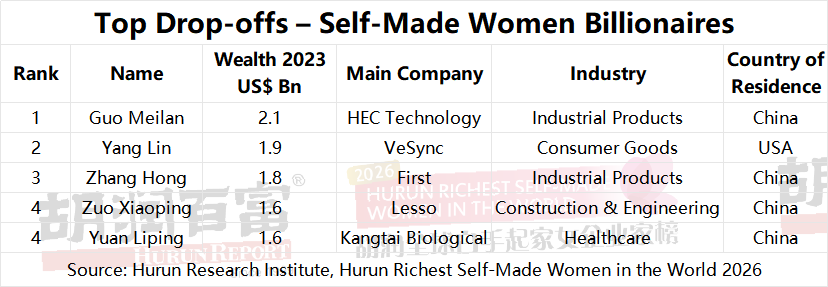
The drop-off table deepens the same story, adding texture to what the losses table only begins to tell. Zuo Xiaoping of Lesso, who never built homes but made the pipes and construction materials, exits the list entirely, the clearest illustration that China's property crisis has hollowed out not just developers but the entire supply chain around them. Yuan Liping of Kangtai Biological departs as the third healthcare name to disappear this year, her vaccine business having peaked during the pandemic and now fading as that extraordinary demand cycle closes. Having built Dongguan's HEC Technology into an electronics powerhouse, 63-year-old Guo Meilan has quietly passed the torch, transferring control and equity to her son in a move that significantly lowered her personal wealth. Zhang Hong of First in Hangzhou rode China's solar photovoltaic materials boom, only to be caught in the overcapacity wave that followed. Yang Lin of VeSync stands alone as the only US-based dropoff and her story, while rooted in the US, rhymes with the same forces at play elsewhere. Her smart home appliance business was one of the fastest-climbing fortunes on the entire list, carried by the pandemic-era boom in home devices. Her drop-off now signals that this particular wave has fully receded, globally, not just in China. Yet her presence as a solitary outlier only sharpens the broader conclusion: nine of the ten names across both tables are Chinese, and every loss; whether in biotech, real estate, food, jewelry, construction materials, electronics, or vaccines, traces back to the same underlying forces: a property market yet to find its floor, a consumer economy rebuilding confidence slowly, and a post-pandemic demand cycle unwinding across industries that once seemed unstoppable.
Table 7: Biggest Losses – Self-Made Women Billionaires
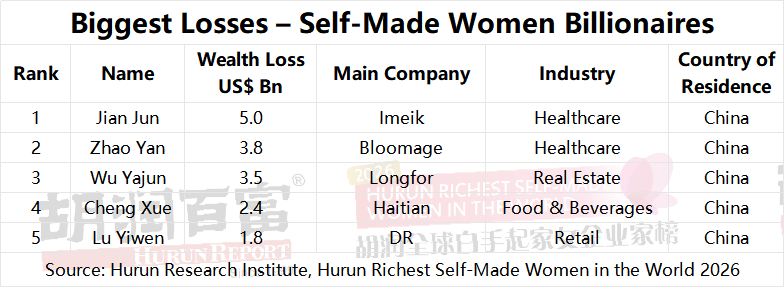
Table 8: Top Drop-offs – Self-Made Women Billionaires
Who are the Youngest?
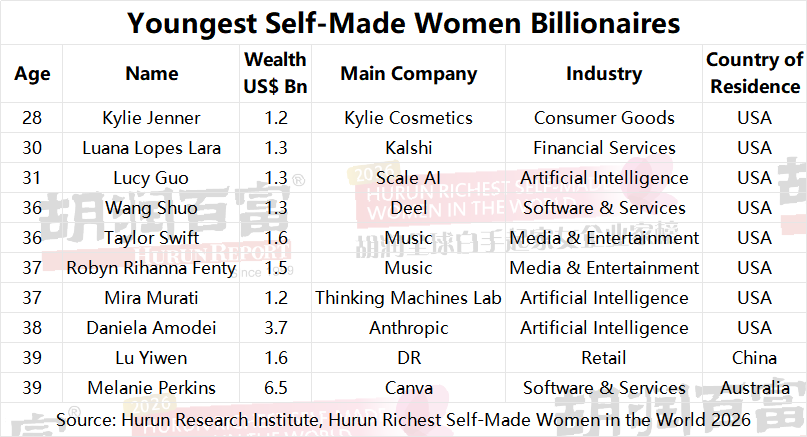
Of the 150 self-made women billionaires, 10 are Under40s, of which 3 are Under35s, and only one is an Under30: Kylie Jenner of Kylie Cosmetics, aged 28.
The 2026 cohort of the world's youngest self-made women billionaires is defined by a decisive shift toward technology and artificial intelligence, with eight of the ten based in the USA, the sole exception being Lu Yiwen of jewelry retailer DR (China) and Melanie Perkins of Canva (Australia). At 28, Kylie Jenner is the youngest, while Luana Lopes Lara and Lucy Guo crossed the billion-dollar mark before turning 32, building their fortunes through fintech and AI. Three of the ten, Lucy Guo (Scale AI), Mira Murati (Thinking Machines Lab), and Daniela Amodei (Anthropic), made their wealth directly in artificial intelligence, marking AI's debut as a meaningful wealth creation category for young women.
Table 9: Youngest Self-Made Women Billionaires
So, Who are the Richest Women in the World?
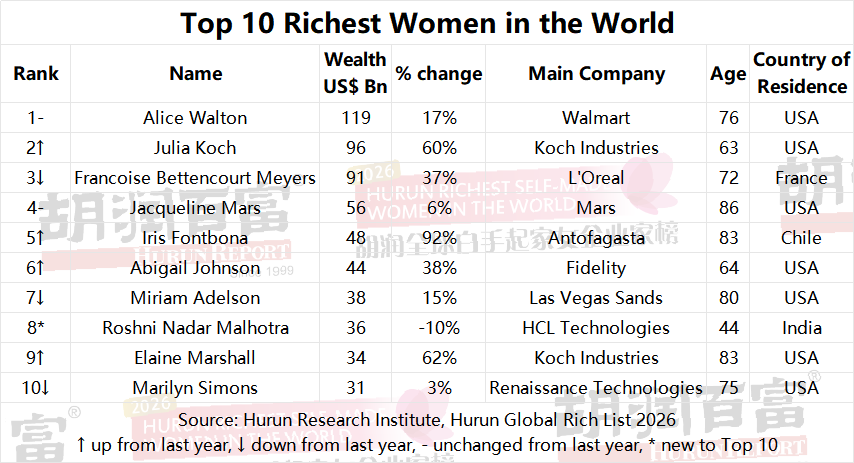
78% or 530 of the 680 women billionaires on the recently-released Hurun Global Rich List 2026 inherited their wealth, led by Alice Walton, Julia Koch and Françoise Bettencourt Meyers. This upper echelon is overwhelmingly dominated by 20th-century legacy family empires in retail, industrials, and cosmetics, alongside modern fortunes derived from marriage and divorce settlements, such as the 11th richest woman, MacKenzie Scott of Amazon.
Diane Hendricks, the richest self-made woman in the world, comes in at 14th, highlighting a stark divide at the absolute top between generational wealth preservation and active, first-generation wealth creation.
Table 10: Top 10 Richest Women in the World
Stats
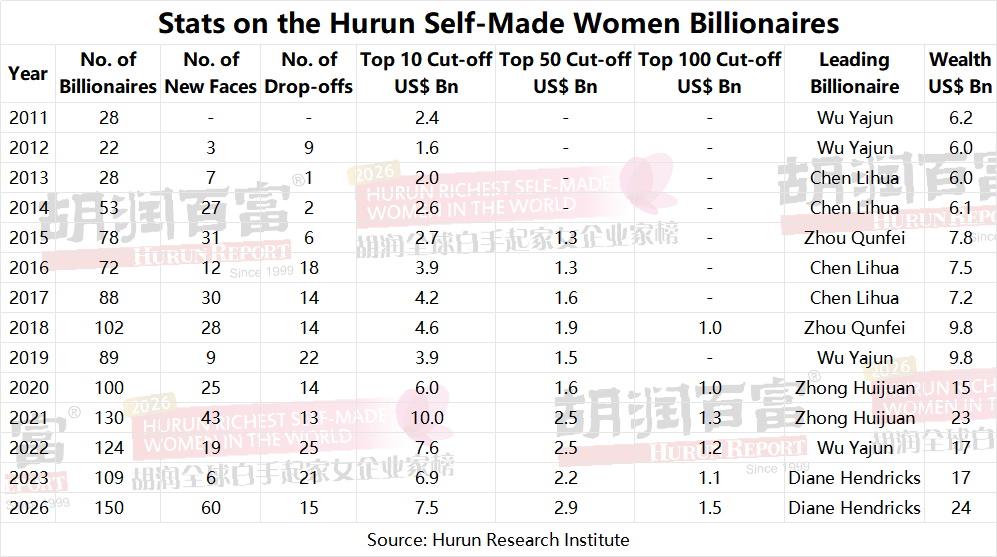
Over the 15-year history of the list, self-made women billionaires have grown from 28 in 2011 to a record 150 in 2026.
The wealth bar rose sharply, with the cutoff to the Hurun Top 10 tripling from US$2.4bn in 2011 to US$7.5bn this year.
The 2026 edition saw the strongest new entry momentum in the list's history, with 60 new faces, while drop-offs fell to just 15, suggesting the wealth base is both broadening and stabilising.
Leadership of the list has rotated among five women over 15 years, Wu Yajun, Chen Lihua, Zhou Qunfei, Zhong Huijuan and Diane Hendricks.
Deaths. The business world lost several prominent self-made women billionaires in the last three years. Judy Love (86) co-founded Love's Travel Stops & Country Stores with wealth of US$6bn; Alice Schwartz (97) co-founded Bio-Rad Laboratories valued at US$2.3bn; and Elaine Wynn (81) co-founded Wynn Resorts with US$1.4bn. These pioneering women built their fortunes across multi-brand retail, pharmaceuticals, and casino hospitality.
Table 11: Stats on the Hurun Self-Made Women Billionaires
About Hurun Inc.
Promoting Entrepreneurship Through Lists and Research
Oxford, Shanghai, Mumbai
Established in the UK in 1999, Hurun is a research, media and investments group, promoting entrepreneurship through its lists and research. Widely regarded as an opinion leader in the world of business, Hurun generated 8 billion views on the Hurun brand in 2025, mainly in China and India, and increasingly in the UK.
Best-known today for the Hurun Rich List series, telling the stories of the world’s successful entrepreneurs in China, India and the world, Hurun’s two other key series include the Hurun Start-up series and the Hurun 500 series, a ranking of the world’s most valuable companies.
The Hurun Start-up series ranks 3000 of the world’s unicorns and future unicorns with the Hurun Global Unicorns Index and the Hurun Future Unicorns Index, split into Gazelles (most likely to ‘go unicorn’ within 3 years) and Cheetahs (most likely to ‘go unicorn’ within 5 years). Hurun also encourages founders with the Hurun Under25s, Under30s, Under35s and Under40s, presenting awards to founders who have built businesses worth US$1mn, US$10mn, US$50mn, and US$100mn, respectively.
Other lists include the Hurun Schools List, ranking the best highschools in the world, the Hurun Philanthropy List, ranking the biggest philanthropists, the Hurun Art List, ranking the world’s most successful artists alive today, etc…
Hurun provides research reports co-branded with some of the world’s leading financial institutions, brands and regional governments.
Hurun hosts regular high-profile events in China, India and the UK, as well as in Boston, New York, LA, Sydney, Paris, Luxembourg, Istanbul, Dubai and Singapore.
For further information, see www.hurun.net.
For media inquiries, please contact:
Hurun Report
Porsha Pan
Email: porsha.pan@hurun.net
Hurun Richest Self-Made Women in the World 2026