AXA · Hurun China NextGen Report 2026
The Hurun Research Institute, the world’s largest compiler of rankings of start-ups, and AXA today released the inaugural AXA · Hurun China NextGen Report 2026. The list identifies China’s second-generation entrepreneurs who excel at preserving family wealth and creating new value.
AXA · Hurun China NextGen Report 2026 Released for the First Time
— Spotlighting China’s second-generation entrepreneurs who excel at preserving family wealth and creating new value
150 outstanding next-generation entrepreneurs make the list.
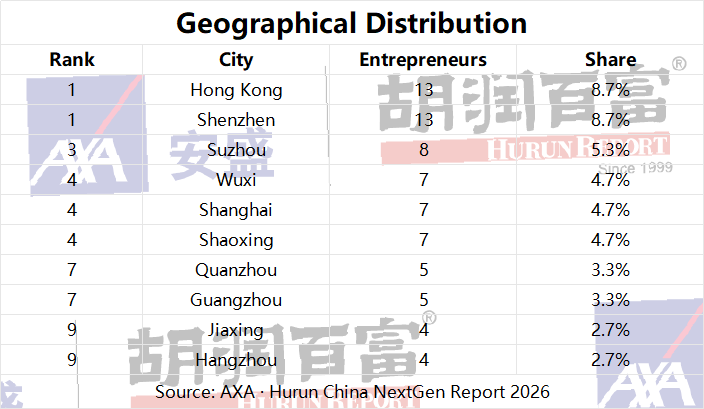
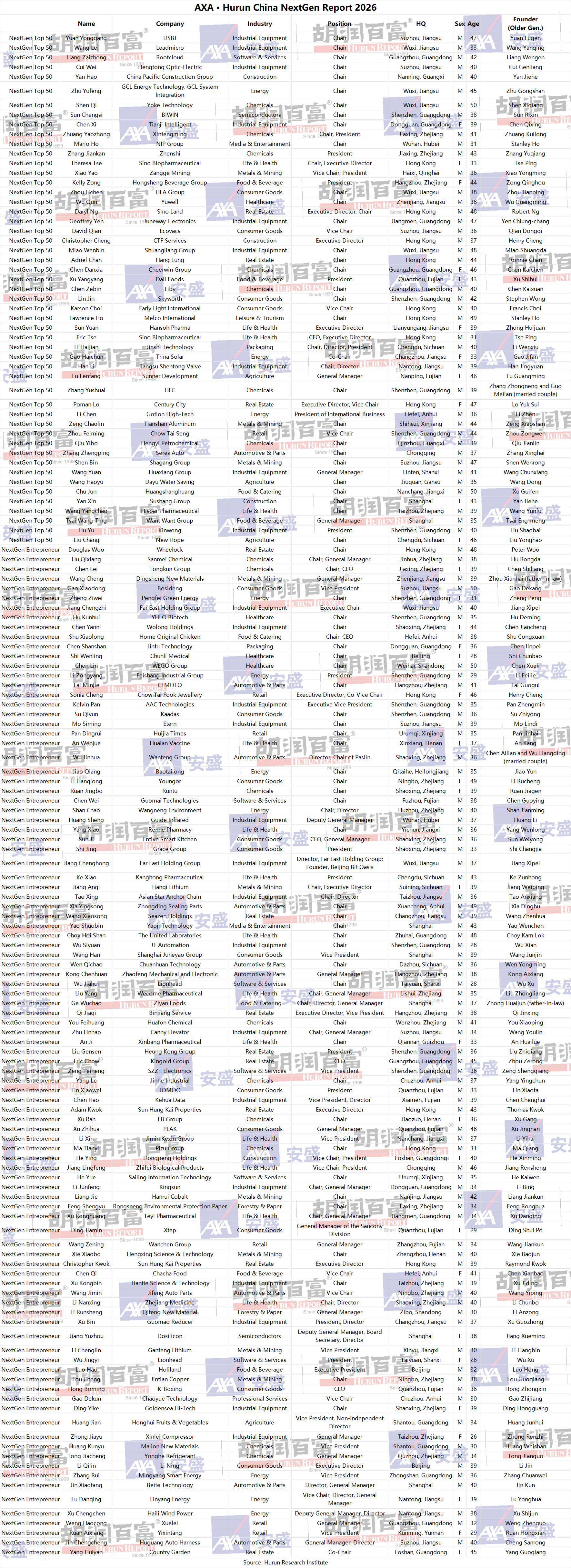
Hong Kong and Shenzhen have the most listed entrepreneurs, with 13 each, or 8.7% apiece. Suzhou ranks third with eight.
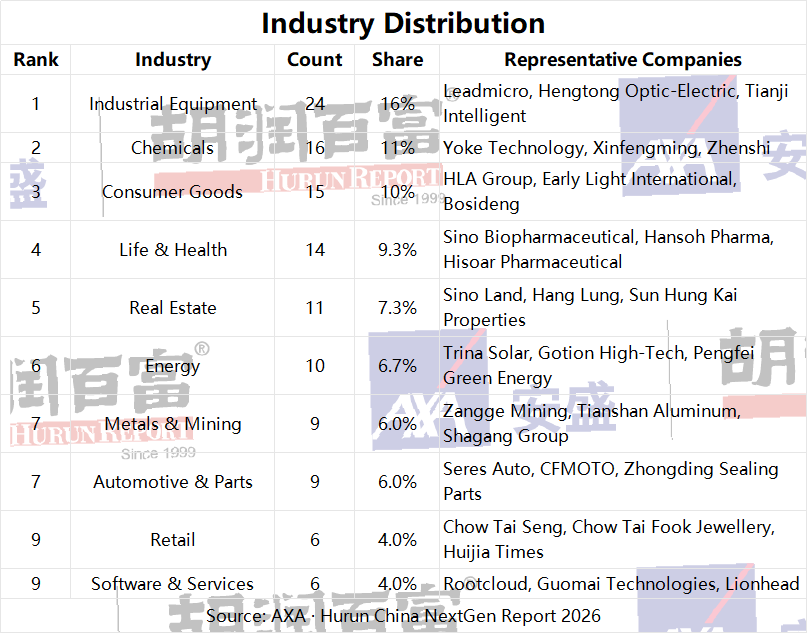
Industrial equipment accounts for the largest share of the companies represented on the list, at 16%. Chemicals follow at 11% and consumer goods rank third at 10%.
The entrepreneurs are 39 years old on average. The youngest, Wu Jingyi and Zhong Jiayu, are just 26.
Overseas education and advanced degrees stand out among this generation. At least 56% studied abroad and at least 47% hold a master’s degree or higher.
Joint management across two generations is the most common succession model. Some 97% have managed their businesses alongside the older generation.
The entrepreneurs take on key roles in their family businesses around age 30. On average, they first join at age 24 and reach senior management at age 29.
Starting on the front line is relatively uncommon. Three in ten began in entry-level roles, including Zhuang Yaozhong, Chair of Xinfengming, Kelly Zong, President of Hongsheng Beverage Group, and Tsai Wang-Ting, General Manager of Want Want Group.
Some 31% have worked outside the family business, including Adriel Chan, Chair of Hang Lung, Mo Siming, Chair of Etern, and Lin Jin, Chair of Skyworth.
After taking over, at least 81% have led expansion into new businesses or sectors, including Wang Lei, Chair of Leadmicro, Cui Wei, Chair of Hengtong Optic-Electric, and Wu Qun, Chair of Yuwell.
At least 37% have driven digital or AI transformation, including Yuan Yonggang, Chair of DSBJ, Zhuang Yaozhong, Chair of Xinfengming, and Zhou Lichen, Chair of HLA Group.
At least 10% have independently founded businesses outside their family firms, including Chen Xi, Chair of Tianji Intelligent, Mario Ho, Chair of NIP Group, and Geoffrey Yen, Chair of Juneway Electronics.
Twenty percent of the entrepreneurs on the list represent companies valued at RMB 50 billion or more, and more than half represent companies valued at RMB 10 billion or more.
Several companies in hard tech and advanced manufacturing have transformed under this generation’s leadership. Under Yuan Yonggang, DSBJ evolved from a printed circuit board (PCB) manufacturer into a provider of optical modules and AI computing solutions. Under Sun Chengsi, BIWIN went from distributing memory modules to becoming a leading full-stack memory chip company. Under Cui Wei, Hengtong Optic-Electric expanded from conventional optical fibre and cable into silicon photonics chips and the entire marine communications value chain.
(Hong Kong, 29 November 2026) The Hurun Research Institute, the world’s largest compiler of rankings of start-ups, and AXA today released the inaugural AXA · Hurun China NextGen Report 2026. The list identifies China’s second-generation entrepreneurs who excel at preserving family wealth and creating new value.
In May 2025, the Private Sector Promotion Law of the People’s Republic of China came into force. China’s first foundational law on the development of the private sector encourages businesses with the capacity to do so to establish and improve modern corporate systems with distinctive Chinese features. By protecting rights such as property rights and operational autonomy on an equal footing, it provides a legal foundation for sound governance and orderly succession at family businesses. The 2026 Government Work Report called for further improvements to the modern corporate system with distinctive Chinese features, stronger promotion of entrepreneurship and support for the development of younger entrepreneurs. Together, the law and these policy priorities set the context and provide institutional support for the next-generation entrepreneurs profiled in this report.
The AXA · Hurun China NextGen Report 2026 features 150 entrepreneurs from 61 cities. It focuses on second-generation successors at China’s privately owned family businesses and assesses both succession and innovation. The methodology uses three core measures: the Wealth Creation Index, the Succession Index and the Innovation Index. Candidates in key governance roles receive additional points.
Rupert Hoogewerf, Chair and Chief Researcher of Hurun Group, said:
“I am delighted to work with AXA, a world-renowned insurance brand, to present this list of second-generation successors at Chinese family businesses.”
"China’s privately owned businesses are at a turning point as large numbers of founders prepare to hand over to the next generation. We expect wealthy Chinese families to pass on RMB 21 trillion over the next 10 years, RMB 46 trillion over 20 years and potentially RMB 77 trillion over 30 years. Entrepreneurs on the Hurun China Rich List are 61 on average, and their children are in their early thirties on average. More than 1,300 of those entrepreneurs are 40 or older and around 300 are 70 or older. Ideally, I think entrepreneurs should have their succession arrangements in place before they turn 70. The Hurun China Rich List has chronicled how the first generation built businesses from scratch. The story to watch today is how their successors build on those achievements and go further.”
“This list is about succession and innovation. Succession means being ready to take over. It calls on the older generation to plan ahead and safeguard the family’s wealth and business. Innovation means ensuring that the business can continue to grow and be passed on to future generations. It encourages younger entrepreneurs to innovate and start ventures so the family business can grow across generations.”
"Hurun has two long-running series of rankings of individuals. The rich lists focus on accumulated wealth, while the U Series (U40, U35, U30 and U25) focuses on value creation. This list looks at how succession and value creation come together, which is what distinguishes this generation of family business successors.”
“The entrepreneurs on the list come from 61 cities nationwide. Hong Kong and Shenzhen lead with 13 each, accounting for 8.7% apiece. Those from Hong Kong include Daryl Ng, Chair of Sino Land, Christopher Cheng, Executive Director of CTF Services, and Adam Kwok, Executive Director of Sun Hung Kai Properties. Those from Shenzhen include Sun Chengsi, Chair of BIWIN, Liu Yu, President of Kinwong, and Zheng Ziwei, Chair of Pengfei Green Energy. Suzhou ranks third with eight.”
“The entrepreneurs and their families have built some remarkable businesses. Their companies include 46 on the Hurun China 500 and three on a Hurun unicorn list. Among the entrepreneurs themselves, 103 have previously appeared in Hurun’s U Series.”
“Advanced degrees and overseas education stand out. At least 47%, or 71 people, hold a master’s degree or higher, and at least 56%, or 84, have studied abroad. The list includes graduates of Wharton, MIT, Harvard and Cambridge, making it almost a map of the world’s leading universities. Chen Xi, Chair of Tianji Intelligent, graduated from the University of Cambridge. Under her leadership, in 2025 the company became the first in the world to deliver force-controlled humanoid dual-arm systems at scale and led the global market in shipments. Liang Zaizhong, Chair of Rootcloud, graduated from Harvard University. Incubated within Sany Group, Rootcloud has since helped companies in dozens of industries, including equipment manufacturing, automotive and electrical equipment, with their digital transformation.”
“Many of China’s first-generation private entrepreneurs are now preparing for succession, and their successors are taking on key roles in the family business around age 30. Listed entrepreneurs first join at age 24 and reach senior management at age 29 on average. The five-year gap suggests that reaching senior management may be an early milestone in succession. At just 23, Theresa Tse became Chair and an Executive Director of Sino Biopharmaceutical. She launched an innovative drug strategy and led its shift from generics to innovative medicines. At 23, Shen Qi took over from his father as Chair and General Manager of Yoke Technology. He led the company’s transformation from a traditional chemicals business into a nationally recognised specialist and innovative ‘Little Giant’ enterprise. Sun Chengsi became Deputy General Manager of BIWIN at 24 and helped it become one of the few companies in China with capabilities spanning research and development (R&D), packaging, testing and manufacturing for both NAND flash and DRAM memory products. BIWIN listed on the STAR Market in late 2022.”
“Joint management across two generations is the dominant succession model. Succession is typically a process of joint management rather than a one-off transfer of power. Some 97%, or 146 people, have managed the business alongside the older generation. Few spend a long period on the front line. Three in ten, or 41 people, started there. Zhuang Yaozhong, Chair of Xinfengming, joined the production front line in 2010 and moved into management three years later. Kelly Zong, President of Hongsheng Beverage Group, graduated in 2004, started in an entry-level role at Wahaha and took charge of Hongsheng Beverage Group in 2007. Some 31%, or 46 people, have worked outside the family business. For example, Wheelock Chair Douglas Woo worked as a real estate corporate finance analyst at UBS before joining the family business. Most joined family businesses directly in management roles after graduating from leading overseas universities, taking on responsibility early and gaining authority quickly.”
“Starting an independent business is another path. Some 10%, or 15 people, have built ventures of their own. Mario Ho, 31, chose to build his own venture outside his family’s core casino business and founded V5 Esports in 2018. It raised RMB 120 million in a Series A round the following year, then a record for a single funding round by a Chinese esports club. Ho founded NIP Group in 2020 and took it public on Nasdaq in 2024, making it the first Chinese esports company to go public and Ho the youngest Asian founder of a Nasdaq-listed company.”
“Only a minority have started their own businesses. Many more people on the list have led new business initiatives than have founded independent ventures. This points to an often overlooked way for successors to innovate. They can build new businesses with room to grow by drawing on the family firm’s existing brand, capital, distribution channels and customer base.”
“After taking over, successors have reshaped how their family businesses grow. At least 81%, or 121 people, have led expansion into new businesses or sectors. This is an important way for them to establish their own track records. Mature businesses already have organisational structures and operating practices put in place by the older generation. New businesses give successors more autonomy and a clearer opportunity to show what they have achieved. After joining Yuwell, Chair Wu Qun set up an e-commerce department. In 2020, he oversaw the launch of a B2B platform, and online sales went on to surpass traditional channels, giving the company a new source of growth. In 2025, DSBJ Chair Yuan Yonggang acquired Source Photonics for RMB 5.9 billion, moving into optical modules and AI computing. DSBJ reached volume production of 200G EML chips and came close to supplying all its own optical chips. The acquisition helped turn DSBJ from a traditional PCB manufacturer into a one-stop provider of AI PCBs and high-speed optical modules.”
“Alongside expansion into new business areas, at least 37%, or 56 people, have upgraded their core businesses by driving digital or AI transformation. After taking over in 2017, Xinfengming Chair Zhuang Yaozhong led the company’s digital transformation, with 5G and the Industrial Internet at its core. He oversaw the development of the industry’s only national-level Industrial Internet platform and a model smart factory. The platform helped the company triple its production capacity to 10 million tonnes in three years. Digital and AI upgrades build on what the previous generation established. The challenge is to make change happen within an existing organisation and its established ways of working.”
Jonathan Li, Chief Distribution Officer, AXA Greater China, said:
“Building on AXA’s longstanding insights into succession planning and our deep understanding of the entrepreneurial community, this research provides a more concrete picture of how a new generation of family business leaders are carrying forward their family legacies while developing new growth momentum into their businesses through innovation, diversification and cross-border expansion. The fact that Hong Kong and Shenzhen are tied as the cities with the highest number of entrepreneurs featured in the ranking also highlights the Greater Bay Area’s unique strengths in industry, talent and international business connectivity. In today’s rapidly changing business environment, business succession is far more than a simple generational handover. It is an ongoing process of strengthening business resilience, enhancing corporate governance and reinforcing long-term competitiveness. As an international insurer focused on the Greater China market, AXA will continue to leverage its global experience and risk management expertise to support businesses and entrepreneurs in achieving smooth succession and sustainable development, while working together to create long-term value for society.”
Geographical Distribution
The listed entrepreneurs come from 61 cities across China, with Hong Kong and Shenzhen each home to 13. Hong Kong has a high concentration of family wealth, and many families started succession planning early. Three families have two second-generation entrepreneurs each on the list: Sonia and Christopher Cheng of the Henry Cheng family, Adam and Christopher Kwok of the Kwok family, and Theresa Tse and Eric Tse of the Tse family. All six took over or started independent ventures five years ago, and together they account for nearly half of Hong Kong’s 13 entrepreneurs. Hong Kong-listed companies’ detailed disclosures on directors also make their roles easier to verify. Shenzhen has many privately owned family businesses approaching succession at the same time. More than 40 years after the Shenzhen Special Economic Zone was established, first-generation founders are generally 60 to 70 years old. Alongside the wave of ChiNext listings, many are now preparing to transfer ownership and management together. Electronics and information technology, semiconductors and industrial equipment are central to Shenzhen’s economy and account for five listed entrepreneurs. In technology-based family firms of this kind, ownership tends to be concentrated and the path to succession clear.
Industry Distribution
Industrial equipment is the largest industry on the list, accounting for 16%, followed by chemicals at 11% and consumer goods at 10%. Together, the three account for nearly 40% of the list. The lead for industrial equipment reflects the timing of succession in Chinese manufacturing. Many founders in the sector set up equipment manufacturing businesses after China began its reform and opening-up, and many are now preparing to hand over around the same time.
Featured Next-Generation Entrepreneurs
Wang Lei
Chair, Leadmicro
Born in 1993, Wang Lei is the son of Wang Yanqing, founder of Lead Intelligent Equipment. He studied computer science and mathematics at Rutgers, The State University of New Jersey, and is among the youngest business leaders on the list. After graduating, he worked briefly at CKD and Jiangsu Hengyuntai Information Technology before joining the family business. As Chair of Leadmicro, he led breakthroughs in China-made atomic layer deposition (ALD) equipment. In 2020, the company pioneered the use of production-scale high-k ALD equipment on 28-nanometre integrated circuit lines, filling gaps in several key processes in China. It was the first in the world to apply ALD at scale in photovoltaic manufacturing and became a leading supplier of equipment for high-efficiency solar cells. Wang led Leadmicro’s 2022 STAR Market listing, making it China’s first listed ALD equipment company. The Wang Yanqing family ranked 133rd on the Hurun China Rich List 2026 with RMB 48 billion.
Cui Wei
Chair, Hengtong Optic-Electric
Born in 1986, Cui Wei is the son of Hengtong Optic-Electric founder Cui Genliang. He took over as Chair in 2021 and assumed responsibility for the listed company’s operations, expansion and global strategy. Cui led the development of 100–400G silicon photonics chips and built a complete value chain for ultra-low-loss marine communications networks, with products reaching multiple countries and regions. He established a smart manufacturing system with “one core, two chains and three support pillars”, helping more than 1,500 companies across the value chain develop together. He also expanded overseas production bases and increased investment in marine energy and communications. In 2023, he led Hengtong’s new energy business and helped its subsidiary Mengguli list separately on ChiNext. Cui Wei and his father ranked 90th on the Hurun China Rich List 2026 with RMB 63.5 billion. Cui Wei also appeared on the Hurun China Under40s 2026 list.
Theresa Tse
Chair and Executive Director, Sino Biopharmaceutical
Born in 1993, Theresa Tse is the daughter of Tse Ping, founder of Sino Biopharmaceutical. She studied finance and healthcare management at the Wharton School of the University of Pennsylvania. After graduating in 2015, she joined the family business as Chair and Executive Director, becoming one of the youngest people to lead a major Hong Kong-listed pharmaceutical company at the time. Six months into her tenure, the company reported HK$14.55 billion in revenue and HK$1.778 billion in net profit. Tse has led the company’s strategic shift from generics to innovative medicines, increased R&D investment and built an international research platform. The company partnered with multinational pharmaceutical companies including Boehringer Ingelheim, Shionogi and Sanofi. In early 2026, it reached a licensing deal worth up to US$1.53 billion with Sanofi for an innovative drug, extending its business development efforts from in-licensing to out-licensing. Tse also led acquisitions including HOB Biotech, LaNova Medicines and Hygieia Pharmaceuticals, strengthening the company’s pipeline of innovative medicines. Her family ranked 122nd on the Hurun China Rich List 2026 with RMB 52 billion. Tse and her mother, Cheng Cheung Ling, ranked 47th on the Hurun Richest Women in China 2026 with RMB 17 billion.
Sun Chengsi
Chair, BIWIN
Born in 1988, Sun Chengsi is the son of BIWIN founder Sun Rixin and a graduate of Oxford Brookes University in the UK. He returned to China in 2012 and became Deputy General Manager of BIWIN’s predecessor at just 24, among the earliest entrants to senior management on the list. He took charge of operations in late 2015 and expanded BIWIN from traditional memory products into edge AI, enterprise storage and advanced packaging and testing. He also led its STAR Market listing and subsequent global expansion. In 2026, Sun led BIWIN in signing long-term procurement contracts with memory manufacturers and pursued a Hong Kong Main Board listing alongside its existing A-share listing. Capitalising on rapid growth in edge AI applications, he built BIWIN into a leading memory chip company with a market capitalisation exceeding RMB 60 billion. It reported first-half 2026 revenue of RMB 15.6 billion, placing it among the leading global memory companies. Sun appeared on the Hurun China Rich List 2026 with RMB 20 billion and also made the Hurun China Under40s 2026 list.
Chen Danxia
Chair, Cheerwin Group
Born in 1980, Chen Danxia is the eldest daughter of Chen Kaichen, a co-founder of Liby Group. She graduated from the University of Sydney in Australia with two master’s degrees with honours in marketing and strategic management. While studying, she served as General Manager of Liby’s Australian subsidiary and secured exclusive China operating rights for seven major Australian skincare brands. In 2008, she took over Shanghai New COGI Cosmetic Co., Ltd., which had changed general managers three times after its acquisition by Liby. She quadrupled sales volume in two years, making it the first cosmetics business acquired and successfully turned around by a major Chinese household and personal care company. Chen took charge of the SuperB division in 2016. In 2018, she led its separation from Liby, established Cheerwin Group as an independent company and became its Chair. She led Cheerwin’s 2021 listing on the Hong Kong Stock Exchange’s Main Board, the first for a company in the Liby group. She went on to expand the mosquito repellent business into an 11-brand platform spanning home, pet and personal care.
Karson Choi
Vice Chair, Early Light International
Born in 1986, Karson Choi is the son of Early Light International founder Francis Choi and a graduate of the University of Southern California. In 2010, at age 24, he took charge of Halewinner Watches, a high-end watch retailer his family bought for HK$400 million. This marked the family’s entry into watch retail. He founded Unique Timepieces Watches Group, representing more than 30 internationally recognised Swiss watch brands, with stores across Hong Kong and later in Macao. In 2021, he entered the media industry as an independent director of Sing Tao News Corporation. Alongside the family’s traditional toy manufacturing business, Choi has developed new businesses in watch retail, media and automotive. An active philanthropist, he founded the Hong Kong Association for the Promotion of Poverty Alleviation in 2018. He received the Gold Bauhinia Star from the Hong Kong government in 2025. As one of Hong Kong’s youngest members of the Chinese People’s Political Consultative Conference, he has encouraged young people to play a role in national development.
Methodology
The AXA · Hurun China NextGen Report 2026 identifies second-generation entrepreneurs who have carried on privately owned family businesses in China and created new sources of growth after taking over. Listed entrepreneurs must be 50 or younger. Candidates must either hold a key management role in a family business, such as chair, vice chair, president, general manager or executive director, and actively participate in business decisions, or have independently founded and led a business of significant scale.
The Hurun Research Institute gathered all publicly available information on the candidates and cross-checked it repeatedly. It weighted three measures to calculate the overall ranking: the Wealth Creation Index (40%), the Succession Index (20%) and the Innovation Index (40%). Candidates also receive additional points based on their positions.
1) Wealth Creation Index. This measures the absolute increase in enterprise value a candidate delivered after taking over. For family business successors, the baseline is the enterprise value when the candidate assumed a key leadership role. For independent founders, the value at the time of founding is set to zero. In both cases, the increase is measured up to 23 September 2026. Candidates are scored on their increase relative to all other candidates, with greater increases earning higher scores. Scores range from 30 to 100.
2) Succession Index. This assesses the scale of the family business and wealth that candidates take on. Scores range from 30 to 100. Family wealth is assessed relative to that of all other candidates, with higher scores for greater family wealth.
3) Innovation Index. This assesses candidates’ ability to innovate and build new businesses. Scores range from 50 to 100. It considers initiatives such as strategic transformation, expansion into new businesses and independent entrepreneurship. More substantial transformations, larger new businesses and greater achievements in independent ventures earn higher scores.
4) Position bonus. Additional points reflect candidates’ actual authority and responsibilities. Board chairs, chairs and executive chairs receive six points. Vice chairs, CEOs and presidents receive three points. Vice presidents, general managers, deputy general managers and candidates in other key management roles receive no additional points.
AXA · Hurun China NextGen Report 2026
About AXA Hong Kong and Macau
AXA Hong Kong and Macau is a member of the AXA Group, a leading global insurer with presence in 52 markets and serving 92 million customers worldwide. Our purpose is to act for human progress by protecting what matters.
As one of the most diversified insurers in Hong Kong, we offer integrated solutions across Life, Health and General Insurance. We are the largest General Insurance provider and a major Health and Employee Benefits provider. Our aim is to not only be the insurer to provide comprehensive protection to our customers, but also a holistic partner to the individuals, businesses and community we serve. At the core of our service commitment is continuous product & service innovation and customer experience enrichment, which is achieved through actively listening to our customers’ needs and leveraging and investing in technology and digital transformation.
We embrace our responsibility to be a driving force against climate change and a force for good to create shared value for our community. Our overall Sustainability Strategy, with emphasis on nature protection, inclusive protection and social resilience, provides a foundation for integrating environmental, social and governance considerations across our business. We are proud to be the first insurer to address the importance of mental health through different products and services and thought leading iconic research. Committed to shaping a sustainable future, we contribute in diverse ways through three distinct roles - as an investor, an insurer and an exemplary company.
About Hurun Group
Hurun promotes entrepreneurship and value creation through high-quality rankings and research.
Hurun is best known for its rich list series, which tells the stories of successful entrepreneurs in China and around the world. Its other major series focus on young companies and entrepreneurs, including the Hurun Unicorn and U Series rankings and the Hurun Pioneers series.
Hurun has become the world’s largest compiler of start-up rankings. Its Hurun Global Unicorns Index features start-ups valued at US$1 billion or more. It and Hurun’s two future unicorn rankings together cover more than 3,000 start-ups worldwide. Hurun Gazelles are the start-ups most likely to become unicorns within three years, while Hurun Cheetahs are the most likely to do so within five years. The Hurun Unicorn Graduates Index covers publicly listed companies in China founded after 2000 and valued at US$1 billion or more.
Hurun’s U Series comprises four awards: U40, U35, U30 and U25. They recognise founders or key contributors at businesses with a degree of social impact, valued at US$100 million, US$50 million, US$10 million and US$1 million, respectively.
The Hurun Pioneers series for companies and young entrepreneurs focuses on start-ups founded in the past decade and founders aged 45 and under.
Other rankings include the Hurun 500 series, which lists the most valuable companies in China and around the world, the Hurun Global Highschools list, which features the world’s top private high schools, the Hurun Philanthropy List, which recognises the most generous philanthropists, and the Hurun Art List, which features leading living artists in China and globally.
Hurun is a leading global authority on China’s high-net-worth population, which it has tracked for many years. It publishes research with financial institutions, real estate companies, local governments and premium lifestyle brands. With China CITIC Bank, it has published the White Paper on the Needs of China’s High-Net-Worth Individuals, the White Paper on China’s Emerging Generation, the White Paper on Family Succession among Chinese Entrepreneurs, the White Paper on the Wealth Management Needs of China’s High-Net-Worth Individuals, the White Paper on Demand and Trends for Going Abroad and the Special Report on Overseas Education. It also published the Report on the Sustainable Development of Chinese Family Wealth with CCB Trust, the White Paper on Healthcare and Eldercare for China’s High-Net-Worth Individuals with Taikang and the White Paper on Corporate Social Responsibility in China with Country Garden. Since 2005, Hurun has also published its Best of the Best report on the brand preferences of China’s high-net-worth individuals.
Hurun aims to be the world’s most recognised platform for promoting entrepreneurship. It encourages a positive attitude towards wealth and helps people pursue their entrepreneurial ambitions. It urges entrepreneurs to value culture and social responsibility as they grow their businesses. Hurun wants its partners to find value in its network and its teams to earn respect in their fields.
Hurun encourages people to aspire to do good and to use their wealth responsibly and with distinction.
For more information, visit www.hurun.net and follow Hurun on its official WeChat account, HurunReport, and on Weibo.
Media enquiries
Anna Dai
Editor-in-Chief, Hurun Group
Mobile: 15102103129
Email: anna.dai@hurun.net